
Elizabeth Sibert
Woods Hole Oceanographic Institution
2025-2026 Distinguished Lecturer
A microfossil history from the bottom of the sea: Sharks, fish, mass extinctions, and 85 million years of global change
Fish are the most diverse group of vertebrates on the planet today, and the type and abundance of fish present in the marine ecosystem depend on the environmental conditions and food web processes in that region. Further, fisheries and fish-centric eco-tourism support multi-hundred billion dollar industries, and fish are a significant source of protein for much of the world’s population. Yet our understanding of the development of this spectacular biodiversity, and how fish respond to changes in climate, habitat, and environment, is limited due to their sparse body fossil record. Ichthyoliths—isolated microfossil fish teeth and shark scales—are the most numerous vertebrate fossils known, and preserve a unique history of the abundance, community composition, and evolutionary history of fish and sharks. While most scientific ocean drilling research has focused on paleoclimate reconstructions and plankton evolution, ichthyoliths preserved in these sediments can provide a unique snapshot into the evolutionary and ecological history of marine predators. In this talk, I draw on the 55+ year legacy of interdisciplinary and collaborative foundational work supported by scientific ocean drilling and use ichthyoliths preserved in deep-sea sediments to explore how open-ocean fish and sharks respond to Cretaceous and Cenozoic global change, from mass extinctions to rapid climate change events, and discuss how these upper trophic level marine vertebrates interact with the dynamic earth system.
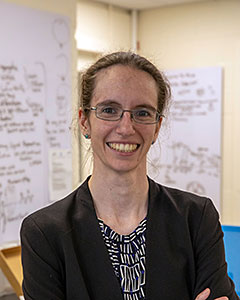
Dr. Elizabeth Sibert sailed on JOIDES Resolution Expedition 378 and is an Assistant Scientist at Woods Hole Oceanographic Institution. Her research lies at the intersection of biological oceanography and paleobiology, investigating how marine ecosystems, and particularly fish and sharks, interact with global change on short and long timescales, reconstructing ancient marine community dynamics using microfossil fish teeth and shark scales preserved in deep sea sediments. Elizabeth received her B.S. in Biology from UC San Diego, and her M.S. and Ph.D. in Biological Oceanography from Scripps Institution of Oceanography. Following her Ph.D., she was a Junior Fellow in the Harvard Society of Fellows at Harvard University. She subsequently held positions as a Hutchinson Fellow and Associate Research Scientist at Yale University before moving to Woods Hole Oceanographic Institution as an Assistant Scientist, where she is thrilled to support the Paleo-FISHES lab. In addition to her oceanographic research, Elizabeth is passionate about improving access to STEM research to folks with disabilities through research opportunities, career development, and outreach efforts. In her spare time, Elizabeth is a professional-level circus artist and coach, a skill set she has been refining for over 20 years.
LECTURE SCHEDULE
- September 18, 2025 — University of Louisiana at Lafayette, Lafayette, LA
- September 25, 2025 — The College of Wooster, Wooster, OH
- September 26, 2025 — The Ohio State University, Columbus, OH
- October 31, 2025 — UC Santa Cruz, Santa Cruz, CA
- February 12, 2026 — Salt Lake Community College, Salt Lake City, UT
- April 16, 2026 — Virginia Living Museum, Newport News, VA
- April 17, 2026 — North Carolina State University, Raleigh, CA