
Resolving silicate weathering dysfunction during the Middle Eocene Climatic Optimum using opal Ge/Si
 Abstract
Silicate weathering has been implicated as the primary process stabilizing Earth’s climate and carbon cycle on geologic timescales, including driving recovery after a climatic perturbation. During the Middle Eocene Climatic Optimum (MECO, ~40 Ma), an enigmatic warming event, the silicate weathering feedback apparently failed to moderate climate, resulting in a protracted period of warming and deep-sea carbonate dissolution. The longer timescale and lack of a carbon isotope excursion place the MECO in sharp contrast to other well-known Paleogene hyperthermal events, for which the silicate weathering feedback seems to have operated as expected. As silicate weathering is also the principal process expected to drive the long-term recovery from anthropogenic CO2-driven warming, it is crucial to understand when and why the silicate weathering feedback is operational or not. To constrain changes in silicate weathering rates during the MECO, I plan to measure Ge/Si across the event in siliceous microfossils from ODP Sites 1051 and 1260 and IODP Site U1511. Preliminary results from IODP Site U1511 suggest that the silicate weathering flux decreased during the warming period of the MECO. This result is contrary to the classical prediction that warming leads to an increase in silicate weathering, but is consistent with a scenario in which decreased silicate weathering allows a buildup of CO2 in the atmosphere—a new mechanism where silicate weathering acts as a driver of, rather than a feedback to, ancient climate change.
Biography
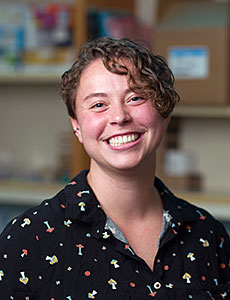
Like so many others, I serendipitously stumbled into the field of geology. Completely undecided about my academic major, I spent much of my first year as an undergraduate at Carleton College sampling a variety of classes, one of which was an introductory geology course. Two weeks into the course I knew geoscience was the field for me. As I devoured the geo-related classes offered, I became fascinated by the study of paleoclimates, especially as analogues to modern climate issues. After completing my BS, I chose to pursue a MS at Utah State University with Dr. Donald Penman on investigating the enigmatic Middle Eocene Climatic Optimum (MECO) by analyzing the inorganic geochemistry of pelagic microfossils. As I worked towards my MS, I realized there was so much more I wanted to explore related to my project than what would be possible during a MS. Therefore, I elected to transition straight into a PhD. Currently in my first year, with support from the Schlanger Fellowship, I plan to use the germanium to silicon ratio (Ge/Si) recorded by siliceous microfossils to better understand the relationship between silicate weathering and climate across the MECO.