
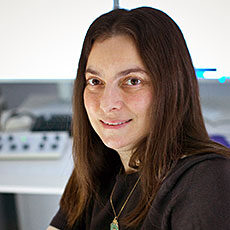
Stefanie Brachfeld
Montclair State University
2025-2026 Distinguished Lecturer
Magnetic forensics in the Scotia Sea: Exploring the deep sea magnetic susceptibility-ice core dust connection
For more than 50 years, international collaborative scientific ocean drilling programs have recovered long sedimentary records from the world’s oceans that serve as recorders of Earth’s complex history. Scientific ocean drilling records have advanced understanding of Earth’s climate and the interconnectedness of its wind systems, ocean currents, and ice sheets. A decades-old puzzle concerns the cause of the striking similarity between late Pleistocene sedimentary magnetic susceptibility records from the Scotia Sea, Southern Ocean, recovered from 3700m below sea level, and atmospheric dust flux records constructed from East Antarctic ice cores recovered from 2900m above sea level. The Scotia Sea is down-wind of a modern dust plume emanating from southern South America, and Patagonia has been geochemically fingerprinted as the source of Late Pleistocene dust in East Antarctic ice cores. However, dust is typically a minor contribution to marine sediment and may not be voluminous enough to drive the susceptibility signal of glacial-marine sediments. Here we present results from International Ocean Discovery Program Expedition 382 to “Iceberg Alley” in the Scotia Sea. In this presentation, I examine time slices across the Pleistocene to conduct “magnetic forensics” by characterizing the magnetic mineral assemblages responsible for the Scotia Sea magnetic susceptibility signal, and compare these with magnetic provenance data from glacial outwash in southern Patagonia and terrestrial and marine till and bedrock from the Antarctic Peninsula, West Antarctica, and East Antarctica. I explore the roles of Antarctic Ice Sheet grounding line locations, the sources of silt supplied to the Southern Ocean, and subsequent redistribution by deep ocean currents to understand linkages between the Antarctic Ice Sheet, southern westerly winds, the Antarctic Circumpolar Current, and Weddell Sea Gyre during the Pleistocene.
Dr. Stefanie Brachfeld is the Vice Provost for Research at Montclair State University and a Professor in the Department of Earth and Environmental Studies. Dr. Brachfeld’s research expertise is in marine geology, Antarctic System Science, paleoclimatology, paleomagnetism, environmental magnetism, and planetary magnetism. She has participated in 11 marine geology and geophysics and paleoceanographic expeditions to Antarctica, the North Atlantic Ocean, and Arctic Ocean, including two expeditions aboard the JOIDES Resolution. Dr. Brachfeld has served as an invited member of advisory boards for multiple national facilities and programs including the Institute for Rock Magnetism, Antarctic Marine Geology Research Facility, U.S. Polar Rock Repository, Antarctic Research and Supply Vessel Scientific Advisory Committee, and the Polar Subcommittee of the Advisory Board to the NSF Geoscience Directorate. She currently chairs the Science Communication subcommittee of the U.S. Advisory Committee for Scientific Ocean Drilling (USAC). Dr. Brachfeld is especially proud of her 70+ Montclair State University student advisees who are now gainfully employed as environmental professionals, geoscientists, K-12 educators, education and outreach specialists, government employees, postdocs and research scientists, professors, and those pursuing advanced degrees.
LECTURE SCHEDULE
- November 3, 2025 — Indiana University, Indianapolis, IN
- December 3, 2025 — University of New England, Portland, ME
- February 25, 2026 — Louisiana State University, Baton Rouge, LA
- February 27, 2026 — University of Houston, Houston, TX
- March 27, 2026 — Appalachian State University, Boone, NC
- April 10, 2026 — Kent State University, Kent, OH