
Susan DeBari
Western Washington University
2025-2026 Distinguished Lecturer
Marine tephra records tell big stories–Highly explosive volcanism and rifting in paradise (the Hellenic arc, Greece)
The Hellenic arc in Greece is the most active volcanic region in Europe, posing hazards that range from tephra fall to pyroclastic flows that travel across both the seafloor and the sea surface, and resulting tsunamis. The most famous eruption in the Christiana-Santorini-Kolumbo (CSK) volcanic field within this arc is the 1600 BCE caldera-forming eruption of Santorini that buried a thriving Bronze Age city and caused widespread tsunamis. The most recent explosive eruption is the ~400-year-old eruption of neighboring Kolumbo volcano, but islands within the Santorini caldera have erupted as recently as 1950. The CSK volcanic field sits within an active submarine extensional basin whose sediments preserve the entire tephra record of the arc since its initiation. IODP Expedition 398 sampled this uninterrupted record of volcanism at twelve sites within the volcanic field, providing an unprecedented opportunity to develop a robust record of hazardous events for volcanic risk assessment. We are also sampling the crystal cargo in particularly noteworthy tephra events to develop conceptual models for magma storage regions and eruption triggers, and how those have changed over time. The record is also being used to decipher long term links between volcanism and tectonics.
There are many exciting and sobering outcomes of Expedition 398, including the recognition of a previously unknown submarine explosive eruption of ancestral Santorini based on our sampling of giant offshore pumice deposits. This submarine deposit volume is six times bigger than the late Bronze Age Santorini eruption, the largest in the region. Pyroclastic flow deposits reached land 30km away. Another previously unknown tephra deposit within Santorini’s caldera provides evidence for an explosive eruption from Kameni volcano in 726 CE. Effusive eruptions from this caldera volcano are well known as recently as 75 years ago, but this VEI 5 eruption exceeds previously considered worst-case scenarios. Other notable expedition outcomes include good matches between seismic and petrologic models for Kolumbo volcano magma storage, the recognition of a far-traveled ash megabed originating from the Kos Plateau >120km away, and documented linkages between crustal faulting/rifting events and volcanism.
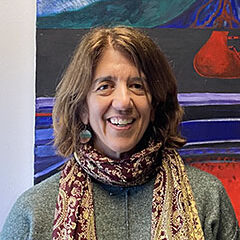
Dr. Susan DeBari is professor emerita in the Geology Department at Western Washington University. She received her B.A. in Geology from Cornell University and her Ph.D. from Stanford University. Susan started her geological career as a field geologist working on uplifted deep crustal sections of ancient volcanic arcs. Over the years, that research focus gradually shifted to the opposite end of the volcanic system, using eruptive products from active volcanoes to better understand hazards. Her current research focus is on the use of crystals carried by tephras and lavas from active volcanoes to decipher their subvolcanic architecture and eruption triggers. She began marine research over 30 years ago with dives into the Izu Bonin trench with the Shinkai submersible and was a co-proponent on several IODP drilling proposals in that arc system. She sailed on her first IODP expedition in 2014, and then again on the Hellenic arc expedition in 2022-23. She will highlight the impressive outcomes that can be fostered by the unique opportunity of multidisciplinary and international collaboration on an IODP research vessel.
LECTURE SCHEDULE
- October 1, 2025 — Louisiana State University, Baton Route, LA
- October 21, 2025 — University of California Riverside, Riverside, CA
- October 27, 2025 — Columbia University Lamont Doherty Earth Observatory, Palisades, NY
- March 6, 2026 — University of Alaska Fairbanks, Fairbanks, AK
- March 12, 2026 — University of Washington, Seattle, WA
- March 26, 2026 — University of New Hampshire, Durham, NH
- April 10, 2026 — West Virginia University, Morgantown, WV
- April 13, 2026 — Kent State University, Kent, OH