
Landslide dynamics, ocean currents, and carbon cycling on the southeastern U.S. Atlantic margin
Date: May 19-21, 2026
Location: Austin, TX, USA
Workshop Organizers: Hugh Daigle (University of Texas at Austin), Anne Bécel (Lamont Doherty Earth Observatory, Columbia University), Jo Grall (CNRS, LIENSs, La Rochelle University), Nathaniel C. Miller (U.S. Geological Survey), James Gibson (University of Texas at Austin), Michel Kuehn (Lamont Doherty Earth Observatory, Columbia University), Ali Mohamed (University of Texas at Austin)
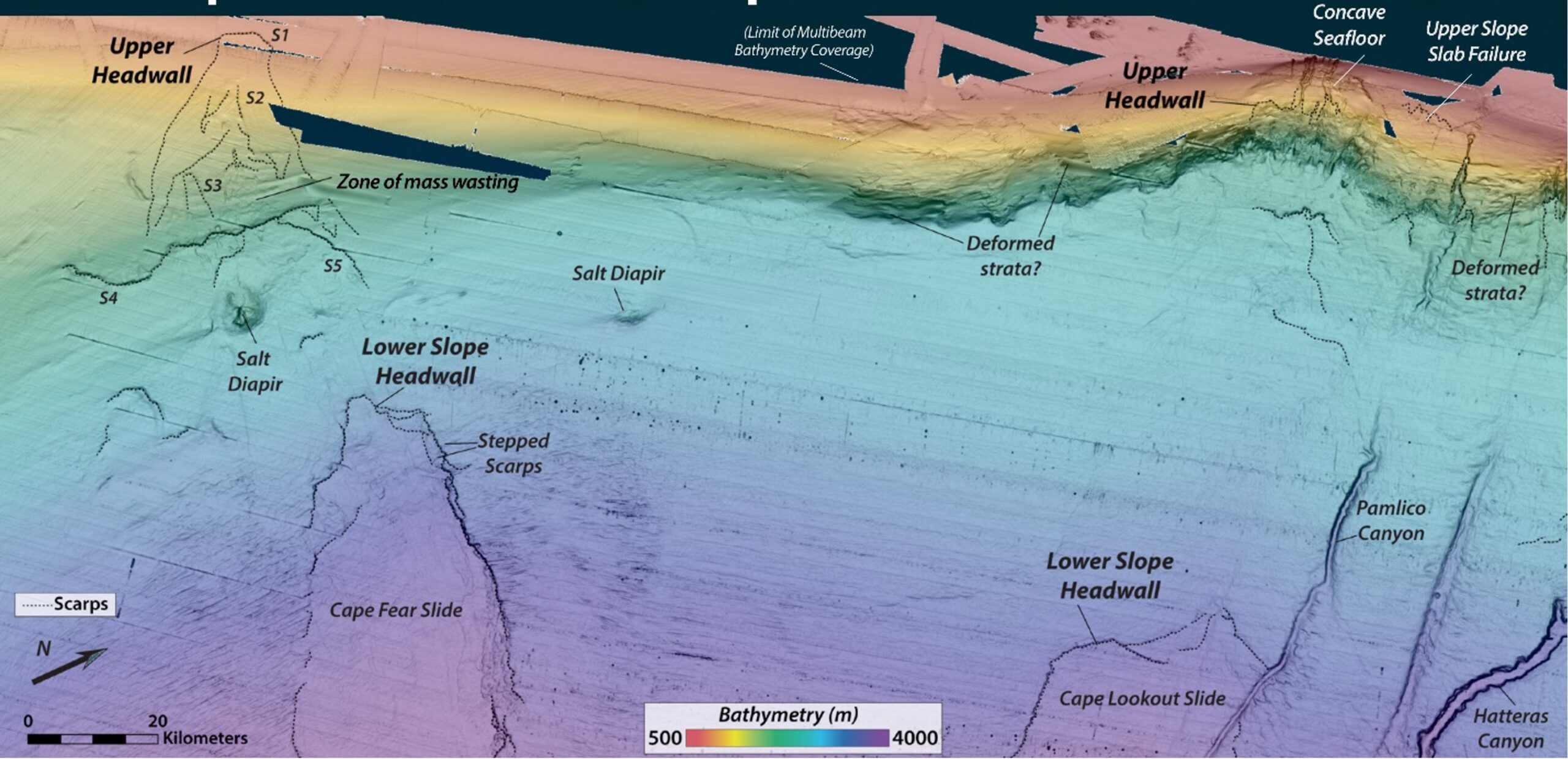
Bathymetry in the vicinity of the Cape Fear Slide showing headwall, scarps, and other features. Figure courtesy of J. Hill.
Submarine landslides are a common geomorphological feature of the North Atlantic passive margin on both sides of the ocean. They threaten large population centers along these coasts with possible tsunamis, act as agents of major mass transfer of material from the shallow to the deep sea, and affect the distribution of the living community on the seafloor. Despite their prevalence, very little about their causes, mechanical and kinetic behavior, and frequency is understood in the context of passive margins.
This workshop will focus on developing hypotheses based around four key questions:
- What are the physical properties of sediments that are primed for failure?
- How do ocean currents and sedimentation patterns precondition slopes for failure?
- What is the timing of slope failures on the southeast U.S. Atlantic margin?
- How much gas and hydrate are present on the margin?
The outcome of the workshop will be a scientific ocean drilling proposal.
Participation
Participants should have expertise in physical properties, including fluid flow and geomechanics; stratigraphy, including dating Neogene sediments; geochemistry; paleoceanography, paleoclimate and sea level changes; and gas hydrates.
We expect about 30 participants. Funds are available to support travel for about 27 U.S.-based scientists. Internationally-based scientists are invited to apply but should contact their program offices for potential support options.
To apply, send a 2-page CV and brief (<500 words) statement of interest to Hugh Daigle by March 1, 2026.
Preliminary Agenda
TUESDAY, May 19
Morning
- Welcome
- Background presentations:
Previous work in the Cape Fear Slide area.
Presentation of new seismic data, including interpreted stratigraphy, margin building processes, and submarine landslide history.
Presentation of new core data, including descriptions, interstitial water geochemistry, and geotechnical tests.
Regional ocean circulation and paleoceanography.
State of understanding of the gas hydrate system.
Afternoon
- Form breakout groups for use throughout workshop.
- Develop specific sets of hypotheses for each key question that can be tested with scientific ocean drilling.
WEDNESDAY, May 20
Morning
- Refine the hypotheses to ensure they are testable, and begin the process of identifying locations where they might be tested by drilling.
Afternoon
- Propose operations at each Site and determine what coring and sampling techniques should be done to test the hypotheses. Groups will generate lists of samples and measurements that need to be collected at sea as opposed to during a shore-based sampling party.
THURSDAY, May 21
Morning
- Start writing text about hypothesis testing and proposed operations that can be crafted into a drilling proposal.
Afternoon
- Finish writing.
- Set agenda for writing the drilling proposal itself.
Questions?
For further information on the workshop, please contact:
- Hugh Daigle, University of Texas at Austin, [email protected]